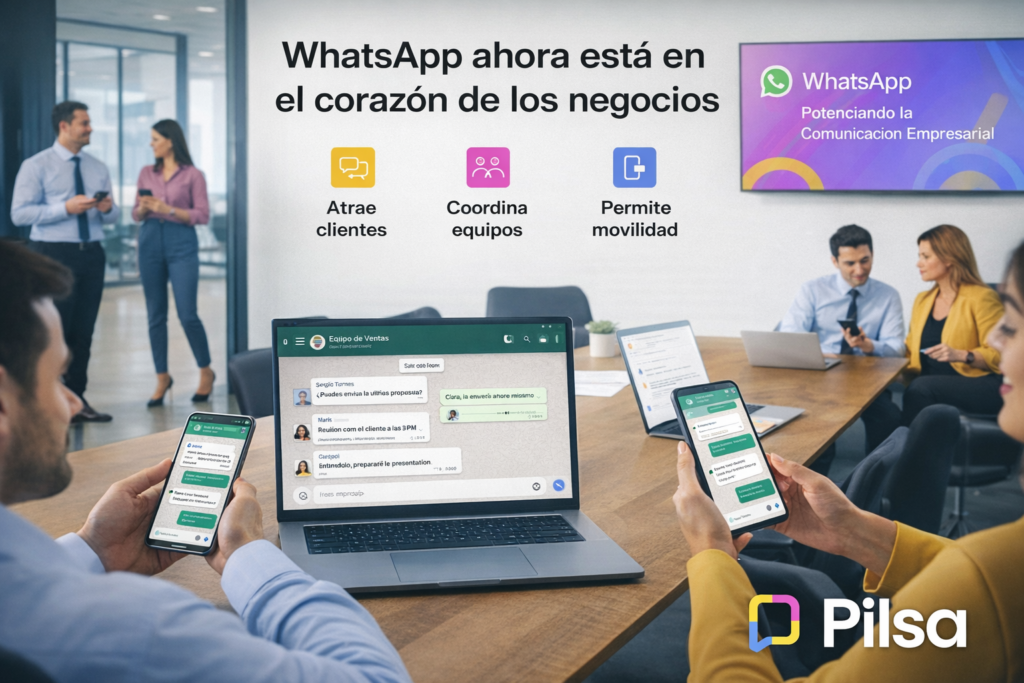

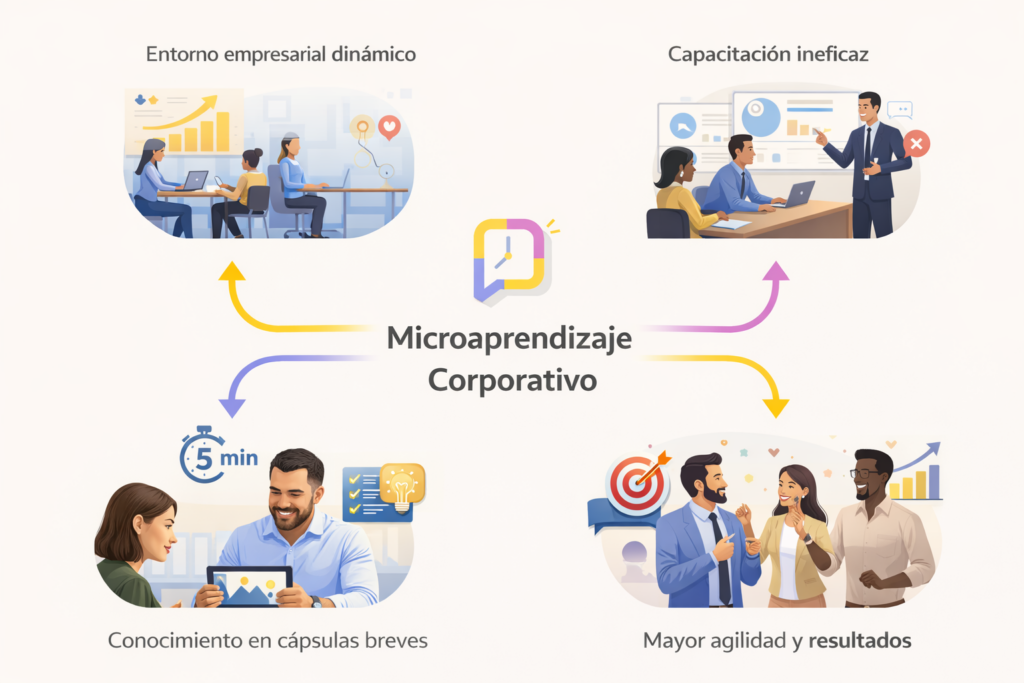
The current business environment is characterized by constant change, pressure for results and the need to adapt quickly. In this context, traditional training models (long courses, extended sessions and generic content) have proven to be ineffective in meeting real business demands. Faced with this scenario, microlearning emerges as a strategic solution that transforms the way companies develop talent.
Microlearning is based on short, focused and actionable content, designed to be consumed in a few minutes and applied immediately. More than a trend, it has become a key approach for organizations that want to improve performance, productivity and continuous learning without slowing operations.
Learning without stopping the business
One of the clearest benefits of microlearning is its ability to fit into the daily workflow. Unlike traditional programs, which force employees to disconnect from their responsibilities, microlearning lets them learn at specific moments of the day: before a meeting, during a break or right when facing a concrete challenge.
This significantly reduces the operational impact of training. Companies stop losing productive hours and, at the same time, employees see learning as a useful tool, not as an additional obligation. The result is higher adoption and less rejection of training programs.

Greater retention and application of knowledge
Several studies have shown that information presented in small blocks is easier to process and remember. Microlearning takes advantage of this principle by removing unnecessary content and focusing on a single learning objective per capsule.
By reducing cognitive overload, employees retain information better and apply it faster. This is especially relevant in areas such as sales, leadership, customer service, regulatory compliance or adoption of new tools, where speed of execution makes the difference.
In addition, microlearning reinforces continuous learning. Instead of depending on a single long course, knowledge is reinforced constantly, which increases the likelihood of behavior change.
Personalized and relevant training
Another key benefit of microlearning is its adaptability. Companies can design specific learning paths by role, area, level of experience or strategic need. This avoids generic training that does not bring real value to all employees.
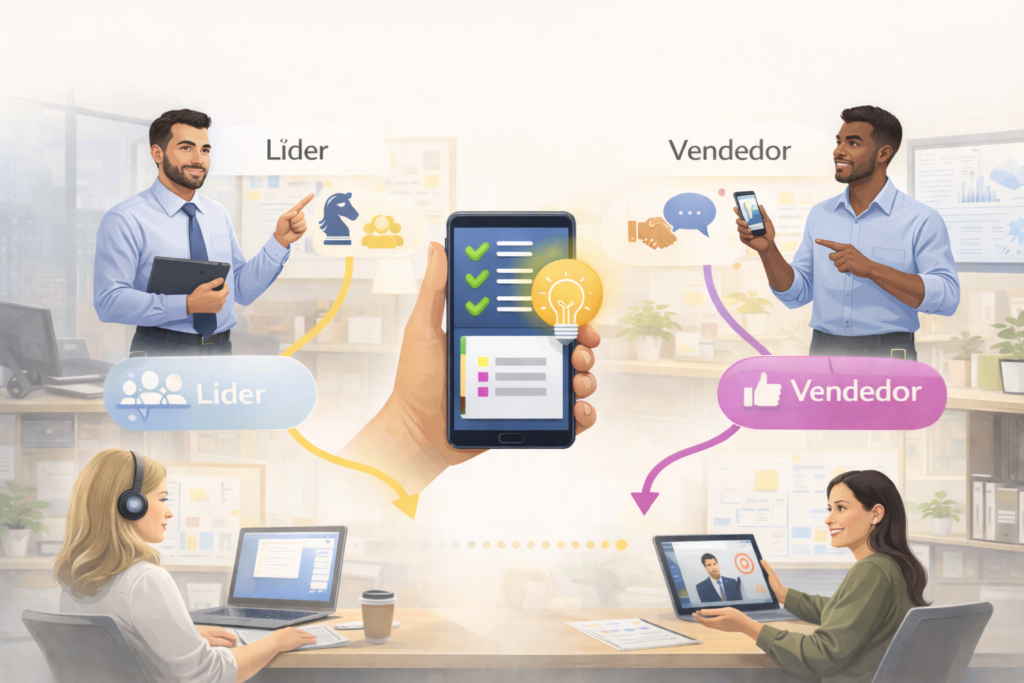
A leader can receive capsules focused on decision-making and team management, while a salesperson gets microcontent on sales argumentation or handling objections. This personalization increases the relevance of learning and, with it, team commitment.
The feeling that what was learned is useful for the job is one of the most important factors in the success of any corporate training initiative.
Agility to respond to change
Companies need to update knowledge constantly: new processes, regulatory changes, product launches, strategic adjustments or the adoption of technology. Microlearning makes it possible to respond to these changes quickly, without redesigning entire training programs.
Creating or updating a capsule takes much less time than redoing a traditional course. This makes learning a strategic ally of the business, able to keep pace with the market instead of becoming a bottleneck.
In addition, the agility of microlearning makes experimentation easier. Companies can test content, measure results and adjust quickly according to real impact.
Clear measurement of impact
One of the great historical challenges of corporate training has been demonstrating its real impact. Microlearning makes this process easier by allowing more precise and actionable metrics.
When working with short capsules, it is possible to measure consumption, completion, frequency, repetition and the direct relationship with performance indicators. This allows talent and training teams to make data-based decisions, optimize resources and align learning with strategic objectives.
The focus moves away from hours of training and shifts to the impact on productivity, performance and business results.

Scalability and cost optimization
Microlearning is highly scalable. Once content is created, it can be distributed to hundreds or thousands of employees without significantly increasing costs. This is especially relevant for companies with geographically distributed teams or high staff turnover.
In addition, by reducing time away from the workplace and lowering the need for lengthy in-person sessions, the indirect costs of training fall considerably. The return on investment becomes more visible and sustainable over time.
Driving a culture of continuous learning
Beyond the operational benefits, microlearning has a deep impact on organizational culture. By making access to knowledge easier and part of everyday life, it promotes a mindset of continuous improvement and constant learning.
Employees stop seeing training as something occasional and start integrating it as a tool for professional growth. This strengthens commitment, motivation and the perception of the company as a place that drives talent development.
Conclusion
Microlearning is not simply a different way of presenting content, but a shift in the approach to managing corporate learning. Its ability to fit into daily work, improve retention, personalize training, measure impact and scale efficiently makes it a competitive advantage for modern companies.
In an environment where time is limited and results are a priority, microlearning makes it possible to develop real skills, at the right moment and with direct impact on business performance. That is why more and more organizations adopt it not only as a training methodology, but as a key strategy for sustainable growth.