

Every year end, the same scene repeats in many companies. Someone from human resources presents the training report: so many hours, so many courses, so many certificates, 92% attendance. And someone at the table asks what difference it made.
There is almost never a good answer. Not because the training did not work, but because nobody measured what really mattered.
Attending is not learning
The most common training metrics are easy to get: who enrolled, who finished, how many hours each person logged. They are useful for administration, but they say nothing about what people can do today that they could not do before.
An employee can complete a customer service course with the video running in another tab. In the report they appear as finished. Their way of serving customers stays the same.
If we want training to earn a place in business decisions, we have to measure something more than presence.
Four levels to measure, without jargon
There is a classic model, proposed by Donald Kirkpatrick, that is still the clearest way to organize this conversation. It divides the impact of training into four levels, and each one answers a more useful question than the one before:
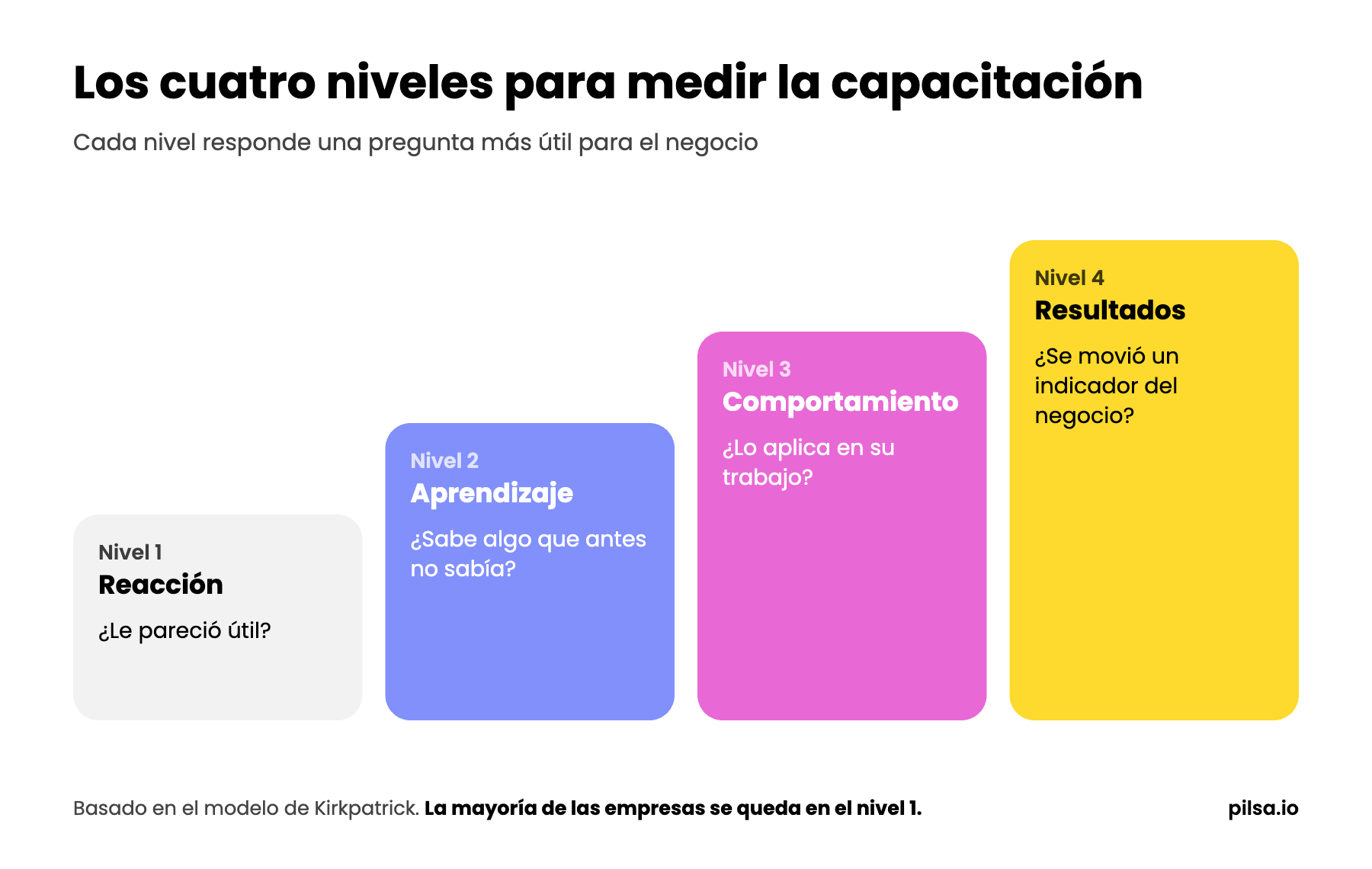
- Reaction: did the person find it useful? This is the satisfaction survey. It helps, but it is the weakest level.
- Learning: do they know something they did not know before? It is measured with short assessments before and after.
- Behavior: are they applying it in their work? Supervisor observation, audits or process indicators come in here.
- Results: did any business indicator move? Sales, errors, complaints, response times or turnover.
Most companies stop at the first level. The real leap is in the second and third, and it does not require big systems. It requires deciding what to measure before starting.
It all starts with a diagnostic
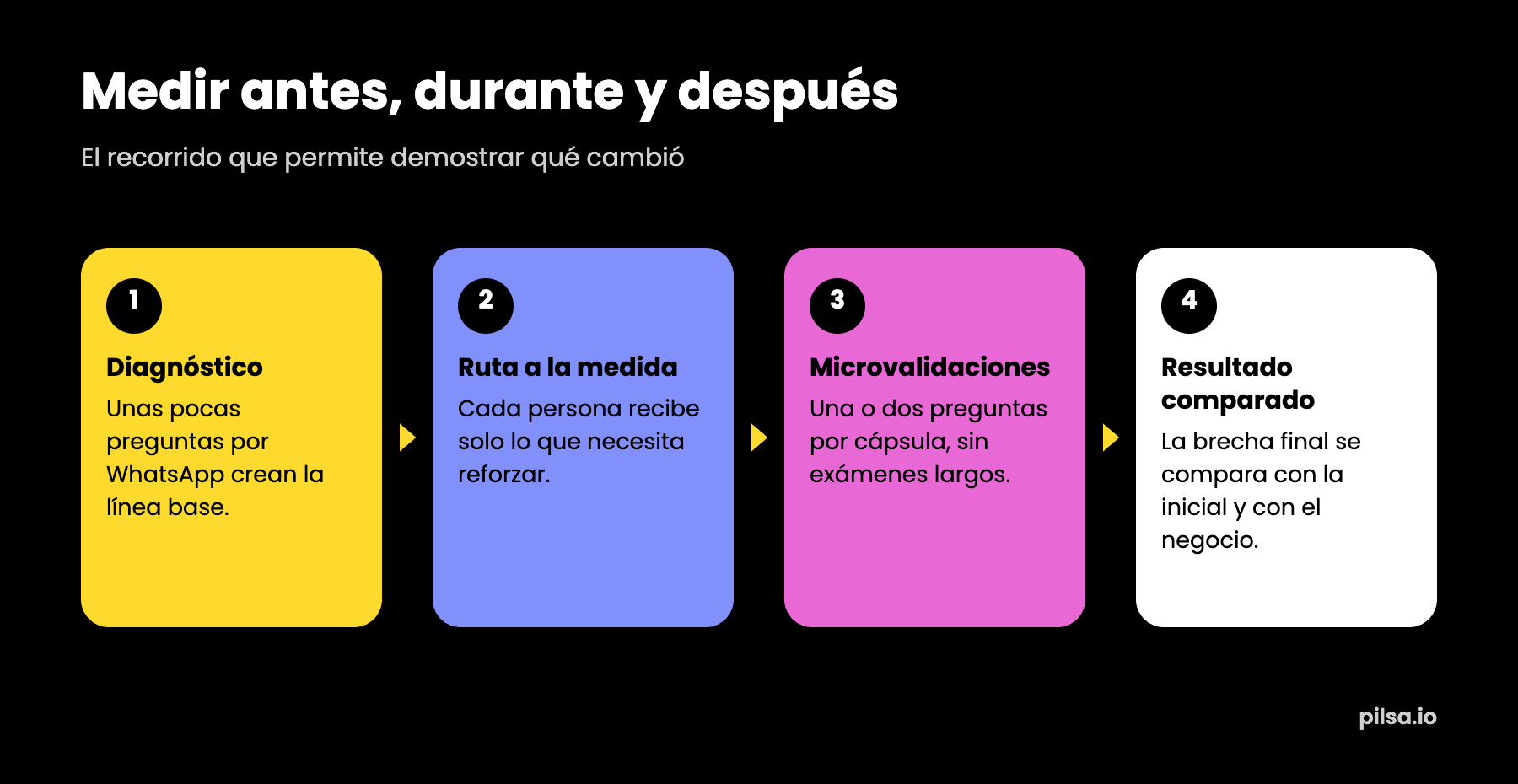
You cannot measure a change if you do not know where you started. That is why at Pilsa we always begin with a short diagnostic: a few questions over WhatsApp that show what each person knows and where their gaps are.
In an employability program in Central America we assessed more than 7,000 young people before assigning them any content. That diagnostic allowed two things: each person received the path they needed, and we had a baseline to compare against at the end.
Without that first picture, any later result is an opinion.
What to measure in practice
If I had to suggest a minimum dashboard for any training program, I would include these five indicators:
- Starting and ending gap: the diagnostic result at the start, compared with an equivalent assessment at the close.
- Real participation: not just who opened the content, but who answered the questions and challenges.
- Progress by topic: in which topics the team improves quickly and in which it stalls.
- Application on the job: a simple check by the supervisor two to four weeks later.
- A business indicator: the one that justified the training from the beginning, such as sales per salesperson, errors in a process or service time.
Five well-chosen indicators say more than a fifty-page report.
Measuring without wearing people out
A common mistake is turning measurement into one more burden: long exams, endless forms, surveys at the end of every module. People answer them just to comply, and the data loses value.
It works better to measure little and often. One or two questions at the end of each capsule, in the same channel where the person learns, give continuous information without interrupting work. This is what we call microvalidations.
How we do it at Pilsa
At Pilsa, measurement is not a step at the end. It is built into the whole journey, through WhatsApp and our platform:
- An initial diagnostic to place each person.
- Paths that adjust to the gaps of each employee.
- Microvalidations in every capsule, with no long exams.
- A real-time dashboard where you see participation, progress and gaps by person, team or location.
That way, the next time someone asks what difference the training made, you will have data to answer.
If you want to keep exploring, I recommend reading how to train teams without stopping operations, why training via WhatsApp works and the benefits of microlearning for companies. You can also see how we have applied it in our success stories.